VET CLINIC
In association with
Mark Andrews, BVM&S CertEP MRCVS, of
Equine Science Update
we are pleased to provide the latest Equine Veterinary Information
___________________________________________________
Mia's Story
A Study of a Discharging Sinus
______________________________
We decided to feature Mia's story as what happened to this mare could have cost her her life but with
the an owner
who was determined she should live, skills of veterinary surgeons and painstaking
aftercare this story has given
hope to a considerable number of horse owners around the world whose horses have suffered a similar fate.
Mia was due to come to us as a three year old in the Spring of 2002 to be backed but unfortunately on a wet and windy evening during the previous Novembershe had a terrible accident which so nearly cost her her life.
|
Bonnie, Mia's owner at the time and her sister, Nicola, had gone to fetch their four horses in from the field. They had caught two of the horses but something suddenly startled the other two and they galloped off down the field. |
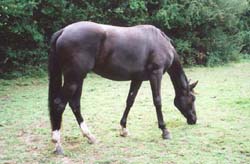
She successfully cleared it with her fore legs and her near hind, but her off hind landed on the wire with the result that Mia fell and became entangled in the fence; her struggling to free herself did not help.
By the time the vet arrived Mia had been freed and got to her feet, but her off hind leg was dangling and with blood pumping out, the scene was not a happy one. Initially the vet wanted to put Mia down but Bonnie insisted on a second opinion so she was moved to the surgery for a more thorough examination.
Mia had severed tendons and ligaments and althoughbare cannon bone was clearly visible - all the flesh had been ripped away - it was not broken; the wire had gone down the leg like a knife cutting through butter and sliced part of the bone away.
The first task was to get the huge gaping wound thoroughly debrided and cleaned before any thoughts about stitching and surgery could be entertained; another vet who examined Mia the following morning was hopeful that the leg could be saved and Mia would, after about a year make a good recovery, although riding her may not be an option.
We can't comment on what treatment Mia received prior to her coming to us suffice to say that it was several weeks before it was feasible to carry out stitching operations as her leg was such a mess. Prior to Christmas further surgery was carried out in which skin grafts were taken from Mia's neck and placed over the main site on injury in order to close over the gaping hole that existed just below hock level and in order to keep the skin over the leg in place as each time dressings were changed the skin slipped down like a rolled down sock.
Once it was confirmed that the skin grafts had taken and dressings changes were not required on a daily basis, Mia was declared fit enough to endure the 2½ hour journey to us. All veterinary attention would now be passed to our vets at Fellowes Farm Equine Clinic and we would be responsible for Mia's daily care and were entrusted with the task of undertaking all rehabilitation work necessary to give her the best possible chance of being ridden again in later life.
On 19th January Mia duly arrived, her leg heavily padded and strapped to provide the best possible support and protection. We were advised that further x-rays had revealed a piece of floating bone above the main site of injury but it was left to our vets to decide on the best course of action.
Having spent such a long time at the veterinary clinic, enduring operations and being separated from her companions, Mia was in good spirits and was not quite so run up as we thought she would be taking account of the stress factor; her neck was still a little tender where the clips had been placed where the skin grafts had been taken and from numerous injections; all in all she was a very lucky little horse not to have done herself even more damage and to have an owner that was prepared to invest so much in her despite the fact that there was no guarantee that she may ever be fit enough to be ridden.
|
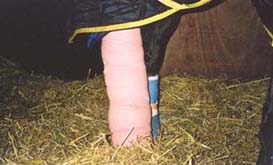
Despite the enormous bulk around her leg, Mia strode out quite happily and it was encouraging to see that she was not lame at the walk. Exactly what lay underneath all that padding would not be revealed until Monday when Stuart (Thorne, [Vet]) took his first look at the injury he had already heard so much about. Removing all the padding was like pass-the-parcel at a childrens' party - how much more was there, what was inside? |
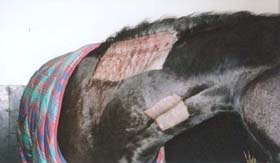
Whilst at the vet clinic in Essex Mia had undergone surgery twice, once to debride the wound thoroughly and insert tension sutures and then to carry out a skin grafting operation in order to close over the open wound as there was such a large tissue deficit because so much had been lacerated and subsequently died off. The photograph shows the large area on Mia's neck where the skin for the grafts was taken. |
|
Stuart began carefully slicing through the layers of padding. As each successive "wrap" was removed we stood motionless. Mia was excellent; she had been sedated so many times in recent weeks (either underside of her neck was a mass of little bumps) that we wanted to avoid this scenario again if we could; she seemed to know we had her best interests at heart and stood stock still. Finally the last bit of padding was removed – and this is what we all saw:
|
|
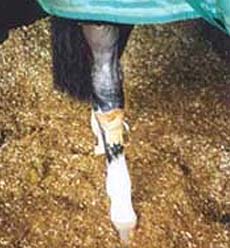
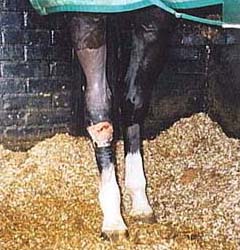
Our very first view of the wound before being |
After cleaning:- the worrying sinus is clearly |
We were all surprised at what was before us in that we expected to find a much larger area of damage and other signs of injury to the leg from having been wrapped in barbed wire, but there was just the one wound. At first sight it looked good, especially after Stuart had thoroughly cleaned it; the grafts has taken but there was something that did not bode well. Right in the centre of the granulation tissue was what is known as a discharging sinus. In simple terms this means that underneath the skin grafts all was not well – there was infection so the wound was not healing in the centre as it should. Mia had a serious problem.
Stuart had been advised by the previous vets that Mia had severed the extensor tendons and that the saphenous vein had died back. That is why now when asked to walk without the support of the huge padding wad around her leg Mia had no control over it in that she moved the leg in a strange sort of circular motion, lifting the leg excessively high and then slapping the foot to the ground with several uncontrolled swings inbetween; nerves were also damaged so effectively Mia had to learn to walk again.
Stuart dressed the leg and strapped it up but with a lot less padding so that Mia had more movement within her hock joint which in turn would encourage her to move around her stable more thus assisting her general circulation and so aid the healing process; Stuart was to return in 3 days time.
|
This time when the dressing was removed we almost dreaded what we would find knowing that there was infection but outwardly the skin had begun healing well and there was visible significant improvementin just 3 days, but unfortunately to no avail as further surgery was an absolue necesity. We had all known prior to Mia's arrival to us that there was a piece of bone that was detached from the cannon bone but did not know its exact position. However by the time of this visit Stuart had received further x-rays from the Essex vets and he knew what was causing the discharging sinus; the piece of fragmented bone was laying directly underneath the grafted woundso there we had the scenario of all that sequestrea meant -left untreated the wound would never heal and in factthe cannon bone itself would literally rot and Mia would need to be euthansed;i mmediate further surgery was the only option to save Mia's life. |
Prior to commencement of her third operationStuart and the senior partner at Fellowes Farm Equine Clinic, Peter Green, took yet more x-rays. We received a warning telephone call that the damage was already more extensive than first thought so the operation would be a little longer and more complex thus lessening Mia's prospects in the long term of ever being fit to ride, but more seriously still was the even greater risk of the damage Mia could do to a much weakened cannon bone when recovering from the anaesthetic.
Peter and Stuart had to scrape away areas of the cannon bone which were already rotting and had crumbled. This entailed cutting open the leg from just below hock level to the top of the fetlock joint and obviously through the skin grafts. Because of the tension required to hold the skin back together pieces of rubber tubing had to be inserted under the skin either side of the extensive incision in order to create a medium to which stitches could be placed. Staples were also put in place. The area which was grafted could not be treated such so no sutures could be inserted.
Later that day we were advised that Mia had recovered well from the anaesthetic, was safely on her feet and eating. We had worried so muchthat Mia might have fractured her leg when coming round because of its weakened state especially as there was no muscle structure to provide support as these had wasted significantly as a result of the initial damage and weeks of box rest.
Because of the fragility of the leg and the need to remove the rubber tubing once the new wound was beginning to knit Mia had to remain Fellowes Farm for about 10 days. Peter and Stuart were keen for Mia to be returned to us a.s.a.p. as the poor little mare had already endured so much. Consequently she was released to our care sooner than would normally be the case in such situations as we had the facilities, time and expertise to carry out the necessary aftercare.
The day after Mia's return to us Stuart came to check nothing untoward had occurred as a result of the journey home and to go talk us through properly what had actually gone on during surgery.
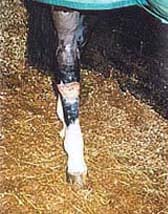
Once again we watched silently as we waited to see what lay under the bandaging this time! What a difference and not such a tidy sight as previously had been the case:
|
This photograph was taken on 11th February 2002 - the day after Mia's return to us from Fellowes Farm. The staples are clearly visible against the dark hair, the marks either side of the staples are where the rubber tubing was and the tiny black specks on the left hand edge of the wound (looking it the picture face on) are some of the grafts that were removed, successfully saved and then replaced. Already, because of the tension, within the area of the granulation tissue the wound is opening up so it was imperative that at each dressing we cleaned it meticulously. |
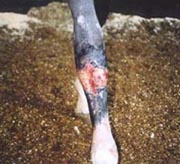
This is a side view of the leg take on the same day. This was a critical time as theopen "cavity" was deep (to the cannon bone) and the risk of infection was at its height. Already visible is wonderful, healthy, pink skin around the outer top edges of the wound - this area had not been effected by the recent surgery so had additional healing time. This was very encouraging as it was a sure sign that the healing process was well underway and any infection was being successfully kept at bay. We were also encouraged by the distinct lack of swelling. |
|
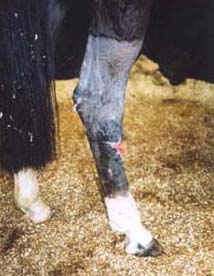
Three days later Stuart came to check that the wound was not opening up too much and that nothing untoward was going on- we all kept our fingers crossedbut to our relief all was well, so well in fact that Stuart took the decision to remove the staples.He also cut away the exuberant granulation tissue (proud flesh) that was beginning to form. This was a pretty bloody sight (granualtion tissue has an excellent blood supply!) and because of the need to keep Mia absolutely still we do not have pictures of this procedure, but that was a small price to pay to avoid sedation; Mia had alreadyhad enough drugs in her system to last her a lifetime, she didn't need anything else if we could help it.
|
Here the picture illustrates what the wound looked like each morning when the dressing was removed. The photo also illustrates just how wasted the leg is above the would. Thorough cleansing was of paramount importance prior to re-application of a fresh dressing and bandaging. The wound has to be kept meticulously clean; Mia was an excellent patient which made the task easier as we had to cleanse deep into the cavity removing any bits of dead skin and all the debris associated with grisly wounds. Care was also needed for the skin around the wound to ensure that no sore points or chafesdevelopedfrom the constant bandaging. Each day saw an improvement - the healing process was very quick, much quicker than anyone had dared hoped would be the case |
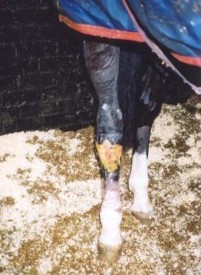
|
Five days later Stuart returned to remove more proud flesh; this exercise wasrepeated a further six days later. |
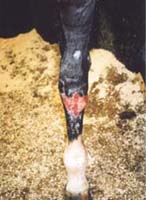
|
To keep the further development of any proud flesh at bay we were given a lotion to apply twice a day after each cleansing so as to eliminate the need for removal by scalpel; at night we applied a light dressing and bandage to keep the wound clean. |
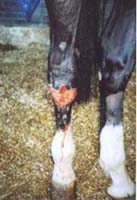
Progress was so rapid and the time spent massaging the leg and walking Miawasrewarded with her gaining more and more control over her movement, we were given the all clear to increase the in-hand exercise and leave the dressing off the leg in the day. Ideally Stuart would have liked to have left the dressing off altogether but Mia loved laying down and was always rolling so the risk of too many bits of shavings, etc.entering the wound was still too great. Although from the pictures it appears that the wound has completely closed over, this was not quite the case at this stage - most of the centre section was matter that was removed at each cleansing; the skin deficeit had not been made up yet.
|
|
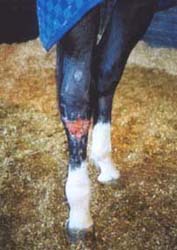
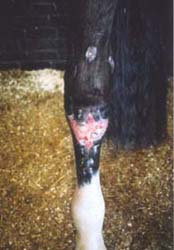
5th March: The cavity is now closing up. |
This picture wastaken just two days later (7th March) but after application of the lotion. |
It is difficult to accept that the right hand photo was taken after the left hand one as the wound appears larger. It is optical illusion, the picture having been taken after cleansing andalsodue to it being taken from a closer range!
7th - 20th March:
We now applied the lotion each morning after cleansing; a light dressing was applied each evening after cleansing. As each day went by we saw various changes to the leg as the lotion burnt into the skin and bits fell away. Some days it almost appeared as if the healing process had taken a backward step but it was only to be expected that there was so much going on within the leg as blood vessels and nerves that had been damaged gradually repaired. The legwas also more swollen on some days than others but, again, this was onlyto be expected.
Mentally Mia now needed more stimulation, she was becoming bored with her (by now) three times aday walk and was virtually trotting around in her box. She greeted us with playful bucks,rears and squeals; she was obviously feeling so much better. So, with veterinary approval it was decided the time had come to begin a little lunging (describing a large oval as opposed to a circle) in between the walking sessions. Mia could not contain her pleasure at this newfound "freedom"; she must have performed every conceivablemovement a horse could execute. Because of her exhuberance we had to limit this exercise to a matter of minutes every couple of days as we did not wish undue strain to be appliedto a leg that had not fully regained its strength. It was incredible to watch her as she knew that her leg was vulnerable - whatever she did she always took the weight with her near hind. Despite outward appearances Mia's muscles had been weakened by confinement and a few minutes play time made her very tired - shespent most afternoons flat out in her stable.
Unfortunately Mia then suffered a slight setback........
On 20th March, during the daily cleansing and massaging session it was apparent that Mia had a slightly tender spot on the inside of her leg; although this was not near the main seat of injury we were naturally concerned that her reaction was an indication of something more sinister going on within the leg. We decided to wait 24 hours to see if ths situation corrected or worsened. Next morning Mia was more sensitive and there was more heat that usual so we called Stuart immediately.
Stuart made an incision at the sore spot (just behind the "red" flesh) and as we all suspected there was infection. Fortunately it was only localised but non-the-less a sample was taken for testing to ascertain the nature of the bacteria and our daily routine now had to include a thorough syringing of the incision.With the release of the "pressure" Mia was morecomfortable; only the next few days wecould only wait with everything that possibly could be, crossed. Stuart returned a few days later with the news that the bacteria was just a normal type of infection, nothing untoward. General improvementof the main wound meant that the daily applications of "anti-proud flesh" lotion were reduced to alternate days. The lotionwas doing its job wonderfully and there was now no further need to apply dressings; we all wanted to cease the night-time bandagingbut being unsure as to whether a minute fragment of shavings had caused the secondary infection as a precaution we preferred to at least keep the wound covered whilst Mia laid down most. |
|
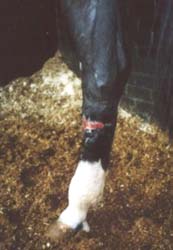
|
This photo was taken on 25th March. We have won the battle of the granulation tissue and the wound now has a much more flattened apearance. Now we just had to wait for some hair to grow; there are small black areas on the wound service (but not very clear on this picture) - these are the grafts. Compare with the ones below taken just two days later. |
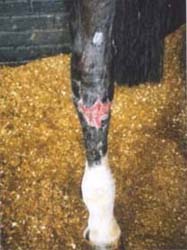
|
It can be seen from these photographs show the wound flattened with the removal of the proud flesh andslowly shrunk in size and also how the appearance literally changed by the day; it has been incredible to watch. |
|
Tendon definition is finally returning to the upper part of the leg, although the fetlock area is still very enlarged - due to poor circulation and damage as well as the on-going effects of severe bruising and trauma. |
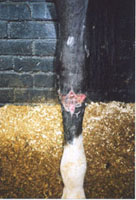
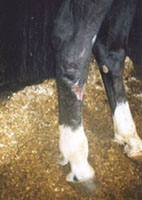
The decision was made to take a set of x-rays for everyone's peace-of-mind just in case a tiny bone fragment may be splintered away and triggered the infection so on 10th April Mia duly had her pictures taken. Ahuge sigh of relief all round - everything was perfect. The lotionapplications couldalso cease as the proudflesh formation had stopped. We could now increase Mia's exercise to continue the muscle building process andimproving her fetlock flexibility; her general co-ordination was also so much improved by this time.
Mia was understandably very boisterous when out so to date we had kept her on a long line for her own protection; cantering and all the kicking and bucking she wished to do were not the problem, we were cautious about skids and slips but the day had to come when Mia had to be let loose, so first things first.
|
We made a small corral in the school so that Mia would realise that she was free but did not have enough space to hardly break into a trot. |
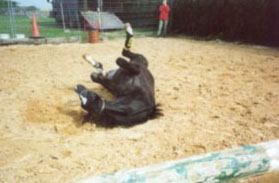
Over the coming weeks we saw such changes both in the wound itself and the general condition of the leg, sometimes quite filled, sometimes not. Whilst Mia came out the box sound, could readily walk, trot and buck(!) then there was nothing to worry about. |
|
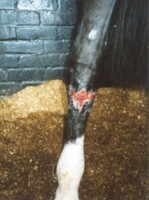
|
|
|
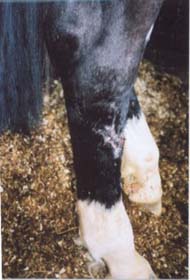
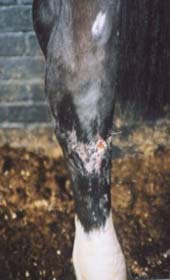
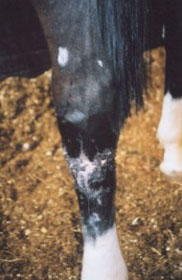
These pictureswere taken on 1st June, 21st June and 4th July respectively.
Mia's strength and co-ordination continued improving throughout the summer months with the combination of polework exercises and gradually bringing the "oval lunge" onto a circle; few peoplecoulddetect that shewas not still not quite 100% in control ofherself - whilst walking and trotting about she was fine, but occasional movements gave her away in the stable.
|
As the rate of change to the wound slowed and, with the increased work load placed upon the leg,swelling would comeup and down by what seemed to be the minute, we decided to cease taking photographs until a much more significant phase was reached.Summer saw Mia being given the whole of the school to play in and generally do whatever she wanted; in time she become more and more adventurous, discovering that she could do whatever she wanted. As Summer drifted into Autumn it was time to start breaking Mia to saddle -her co-ordination was now perfect. |
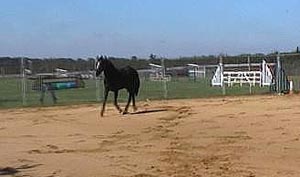
Naturally by now Mia was excellent to lunge and obedient to the voice - when she paid attention; she could be excused for letting herself be distracted, after all she was a young horse that had endured months of restriction and being outside was exciting. Over the winter months Mia's work increased further with long-reining work of which she had plenty to help her general physical development.
|
|
|
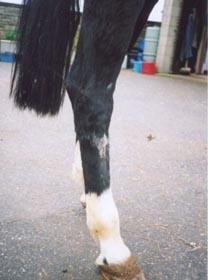
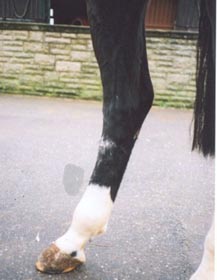
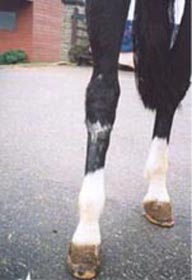
Soon after Christmas we backed Mia but were mindful not to do too much as the leg still needed time to regain its full strength. Then came a dramatic change of events .....
Mia's owner signed her over to us because she was getting married and wished to start a family. We decided that as Mia had missed out on her "baby" life, being confined to a stable instead of playingin the field with some pals, she would be turned out for a 12 months which would not only benefit the leg but also the mare's mental outlook.
Mia soon became firm friends with our welsh cob, Tricky, and miniature shetland, Thomas. We saw her mentality improve so much as she chilled out in the long hot summer of 2003.
Mia is now in Derbyshire with a lovely family whom adore her. All in all a very happy ending to what could have been a tragedy ... on 2 occasions - firstly the intial accident itself, and secondly the consequences of the sequestrea.
__________________________________________________________________________________________
Please click through to the EQUINE SCIENCE UPDATE
website for more articles to read plus information on how to subscribe to a monthly newsletter.
_________________________________________________________________________________________
-