REHABILITATION - AFTER INJURY
HORSES that have suffered a serious illness or incurred an injury may need a long period of time, firstly to convalesce and then to be gradually returned to fitness. The care and correctness of that working programme is paramount as in many cases in can mean the difference between the horse having a future or having to retire.
The story behind the pictures below:-
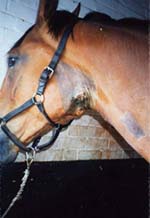
IN brief, following a routine injection of buscopan for a very mild colic, the swelling as pictured on the left came up. By the time the horse was admitted to the RVC a severe reaction had already taken hold and shortly after the neck "burst open" (Picture - right). Following 2 weeks of intensive care the the horse was allowed home but in less then 24 hours he had to be rushed back to the RVC - he was haemorraghing badly. The bleed was stopped, only to recur within hours.
|
|
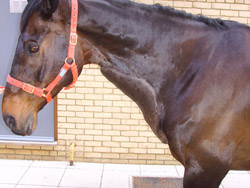
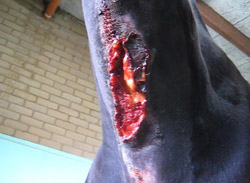
THE jugular vein was tearing so understandably there was considerable blood loss. Vets had no option but to tie off one of the veins - fortunately horses can function ok with just one side (Picture below left). After another week of intensive care the horse was once again allowed home to rest prior to a rehab programme being put in place. Due to the stress, trauma and difficulty eating at times, there is much weight to be regained and of course muscles to be restructured and toned.
|
|
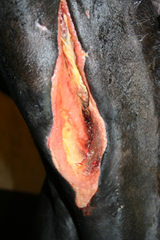
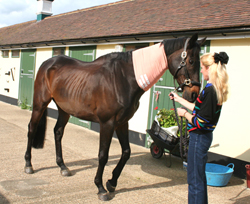
THIS horse is now restored to full fitness, with his new rider and back in the dressage arena. And despite the extensive wound the number of white hairs can be counted on one hand!
A Tie-Back
 |
THIS horse had already been hobdayed when he arrived with us to undergo a schooling programme. |
DEPENDING upon the nature of original problem, once a horse has been released from hospitalisation a further period of treatment may be required, necessitating the application of drugs or attention to dressings to wounds or surgical sites. We admit horses that require such further intense treatment as may be directed by veterinary surgeons and arrange all chiropractic, physiotherapy and massage treatments that may be necessary.
HOWEVER we recommend that horses needing intensive therapy, such as laser treatment, are first admitted to an Equine Therapy centre or similar before coming here as we do not have such equipment on site and such treatment is very specialist.
A Discharging Sinus
A discharging sinus occurs when there is a foreign body within the body which the horse's system tries to eradicate but cannot.
|
SURGERY is often the only option in such cases as the offending sequestra has to be removed otherwise there is continual infection although in some cases sequestrae can remain situ if sited well well away from the site of an open wound. |
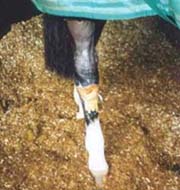
|
DEPENDING on the seriousness of the situation, surgery can often result in a much larger wound area and the most meticulous care is essential to ensure against infection. |
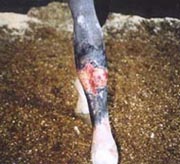
FOLLOWING several months of intense nursing and physio, normal leg co-ordination returned despite the loss of nerves and a severed tendon. |
|
Sarcoid Removal
OF COURSE not all treatments result in a horse being confined to barracks for weeks or months on end; but even seemingly simple operations cause turn out to be a bit more complex that first thought.
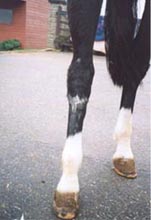
THIS sacoid is positioned within the folds of skin under the forearm (foreleg stretched forward for benefit of photograph). For months it remained very small and virtually unnoticeable but then quite suddenly decided to assert its presence! |
|
THE offending sarcoid proved to be almost 4 inches in length! This meant that the resultant incision was much longer; it extended over the entire underside of the foreleg! |
|
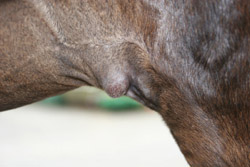
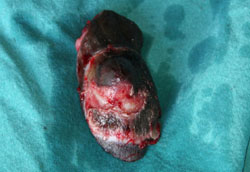
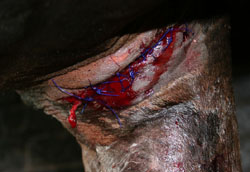
THIS has meant that the horse had to have 23 days of not just box rest, but tied up, so that he did not stretch the wound and dislodge the stitches as the wound was so large and deep.
OF COURSE this also seriously interrupted his training. But just 28 days after removal of the stitches the horse had returned to such super fitness that he was able to attend a two-day dressage training clinic with Paul Hayler. We will be pleased to provide any further information.
Please visit the VETERINARY CLINIC for articles and information on healthcare matters
and for the full story of the horse above.