VET CLINIC
In association with
Mark Andrews, BVM&S CertEP MRCVS, of
Equine Science Update
we are pleased to provide the latest Equine Veterinary Information
___________________________________________________
Equine Anaesthesia
We were invited by Peter Green of Fellowes Farm Equine Clinic to observe the investigation of a stifle joint to try to ascertain the cause of lameness.
Stuart Thorne was anaesthetist.
The number of cases of equine anaesthesia are on the increase as surgical procedures become more advanced. However what actually occurs is the "great unknown" for many owners so by reading this article you will hopefully feel a little more enlightened.
___________________________________________________________________
For some veterinary procedures it is necessary to have the horse totally immobile and oblivious to pain; this is achieved by general anaesthetic.
The transition from full consciousness to the unconscious state is known as “induction” and this transition is achieved by the administration of anaesthetic drugs, such as diazapan, which are either injected or inhaled.
The patient is brought to a well-padded box adjacent to the operating theatre. The normal procedure is then that a pre-med is given i.e. a tranquilizer followed by the anaesthetic dose a few minutes later, the dose rate of which depending upon body weight of horse. If a horse is particularly ill or in a severely depressed state, then the dosage rate is reduced accordingly. Also the application of different combinations of tranquilizers and anaesthetic agents in variously differing proportions may permit a general reduction in the dose of all the agents given, which in turn minimizes the consequential depressant effects that these drugs have on horses. As the anaesthetic takes effect the horse drops to the floor;assistants are on hand to ensure that the horse does not bang its head or that its legs are not trapped under the body.
As soon as the anaesthetic state – unconsciousness - has been achieved it is imperative to get the horse moved into the operating theatre as quickly as possible. Ashorses are suchlarge, heavy animals, this is done by a winch. All four feet are hobbled and the horse is gradually raised up and tipped upside down; as the hobbles are attached to an overhead track the suspended horse can be readily moved directly onto the operating table.
Once on the operating table (which is thickly padded) the horse remains on its back for the duration of the surgical procedure being effected. However if, for example, undergoing particularly lengthy surgery or the patient is heavily in-foal, then the operating table is tipped so that the horse lays more on its side.
The state of unconsciousness obviously has to be maintained for as long as the surgical procedure requires so further doses of the anaesthetic agent are required. At one time this was via injection but these days the methods employed are the same as they are for people, so the horse is connected to an anaesthetic machine. An endotracheal tube is introduced via the mouth and into the trachea; this is then connected to the anaesthetic machine and as the horse breathes it takes in a mixture of oxygen and a gaseous anaesthetic agent. The depth of anaesthesia is controlled by adjusting the concentration of anaesthetic in the oxygen given to the horse. In cases where surgery is prolonged it may be necessary for the horse's breathing to be assisted so some of the more sophisicated machines have a bellows-like device which will actually push oxygen into the horse's lungs.
Procedures within the operating theatre are very strict. All equipment is sterilised and all attendants “scrub up”, wear gowns and masks -everything is just as it would be for people in hospital. The area subjectof the surgery, whether it be a leg, the neck,the body, etc.is thoroughly scrubbed, shaved and scrubbed again;sterilised sheets are then laid over the patient.One of the sheets used hasa"transparentwindow" which has an adhesive on the underside (like a giant sticking plaster);this is placed over the point on the body where the vet is to work and it is literally stuck in position; the vet thencuts through the "window" to access the operation site, the adhesive ensuring the sheet remains in-situ, thus maintaining a sterile working environment.
|
As Peter is working on the leg of this horse, it needs to be kept straight thus it remains attached via a hobble to the winch. The working area is clearly visible through the "clear window" in the sterile sheet. Peter has made an incision through the sheet and into the leg. |
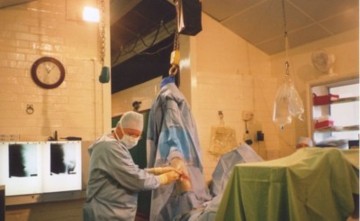
Throughout surgery one vet or “anaesthetist” manages, maintains and monitors the horse and its vital signs; he (she) is in complete control of the proceedings and it is upon his (her) say-so as to whether an operation continues or is aborted should a horse’s life becomes endangered for any reason.
Whilst whatever procedure is being carried out, the anaesthetist constantly monitors the cardiac output (heart rate), blood pressure and respiration of the patient. The readings of each are charted onto a graph and from this data the immediate attention of the anaesthetist is drawn to any changes that occur so that at all times he knows exactly the condition of his charge. However he (she) does not just rely on the monitoring machines for this information – manual checks are made of the pulse, eyes and other membranes to ensure that nothing is missed that might indicate that all is not well.
|
The black "ball"is the breathing bag through which the various gases pass as the horse inhales and exhales. Even as an observer on the day I had to be fully kitted out with gowns and mask. |
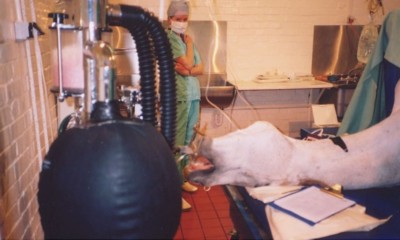
Here you can see Stuart manually checking the horse's pulse; his chart of heart rate, blood pressure and respiration rates is readily to hand.. |
|
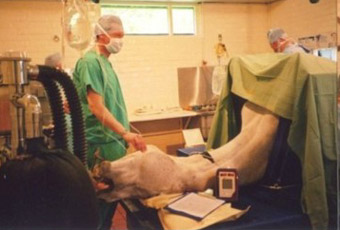
The following pictures are specific to the surgical procedure being carried out - investigation of the stifle joint.
|
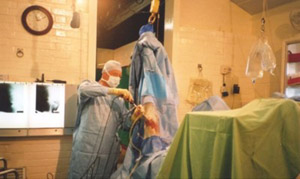
The leg has been pulled into a straighter position in readiness for insertion of the camera. |
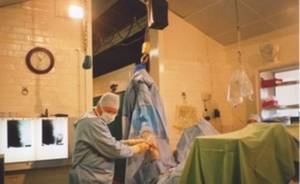
Peter is inserting the microscopic camera into the leg and gradually positioning it within the stifle joint. |
|
|
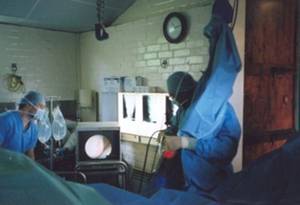
On the tv screen you can see inside the stifle joint. |
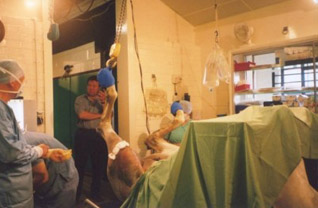
The investigative surgery is now complete Peter is dicussing proceedings with Fred. |
|
Once the operation iscomplete the application of the anaesthetic drug is stopped so that the horse then breathes pure oxygen for several minutes, after which he is “disconnected” from the anaesthetic machine and the other monitoring equipment. The horse is transferred to the recovery room which is has thick padding to the floor and walls, plus is darkened,so that the risk of injury is kept to the minimal as the horse comes round.
Whilst the horse slowly regains consciousness a vet remains with it; he is watching for visible attempts by the horse to swallow by itself because until this point in time the endotrachael tube remains in place to ensure that the tongue is not swallowed.
The time taken to achieve full recovery depends entirely on the individual and the effects the drugs have had on him; the horse’s temperament and its physical condition prior to surgery also coming into play.
Recovery can be a traumatic time for all concerned as some horses, bewildered and confused, try and stand before they are really physically ready; there can be much struggling, kicking and general struggling during which time the horse can injure itself. The risk of a horse fracturing a limb is ever present and sadly this does occur so in severe cases where a horse is having a particularly violent reaction, it is necessary for it to be restrained and kept on the floor which is achieved by laying over the head and neck; once on its feet some horses require a little support until the wobbles have ceased and this is done by propping the head and tail.
Unfortunately anaesthesia is not without its dangers. A horse being such a large animal can it itself cause complications because of the pressure the bodyweight places on the muscular structures; cells can rupture. Sometimes a horse can be lame or unable to bear weight on one of its limbs (post-operative myopathy); this is usually the result of a horse being in dorsal recumbancy (i.e. completely upside down) for a long time. This is why some equine hospitals have operating tables have a tilting mechanism so that horses can be laid on their sides so as to avoid this.
Horses like people reaction differently to anaesthetic agents. The mere administration of these drugs causes blood pressure, heart rate and respiration to drop. Overdosing, particularly of an already sick horse can compromise it to the extent that severe cardiovascular depression is induced and death can then follow. At the other end of the spectrum some horses seem to be actually stimulated by anaesthetics or fight them; in such instances the administration of a different drug or different combination of drugs is required.
* * * * * *
We thank everyone concerned at Fellowes Farm and of course the mare's ownersfor allowing us to observe proceedings.
__________________
______________________________________________________________________________
Please click through to the EQUINE SCIENCE UPDATE
website for more articles to read plus information on how to subscribe to a monthly newsletter.
______________________________________________________________________________